
Digital Safety Fundamentals

Learn essential skills to protect digital assets, navigate cyber threats, and maintain secure online environments in any professional or personal context. If you want to become more resilient against digital risks, understand critical security measures, and contribute to a safer digital landscape, this course is for you.

Course Overview

Digital safety is a fundamental skill for individuals and professionals, especially because nearly 80% of organisations in Singapore have experienced cyber attacks. From sensitive personal information to critical organisational data, it is important for everybody to understand how to safeguard against cyber threats. Your ability to recognise, respond to, and prevent security incidents directly determines the integrity of your digital interactions and the security of valuable data.

Digital Safety Fundamentals is a 2-day course designed to equip you with the knowledge, plans, and practical steps you need to handle digital threats safely and effectively. You’ll dive into common online dangers, learn about key rules for protecting data, and pick up proven methods to respond to cybersecurity incidents, empowering you to effectively protect yourself from potential daily scams. This will help you make your online presence stronger, mitigate potential cyber risks, and help build a safer digital future.

Course Highlights

  • Illustrate common data breaches and security incidents such as hacking, phishing and malware, and recognise their different forms and potential impacts on individuals and organisations.
  • Interpret the Personal Data Protection Act (PDPA) and understand the key principles for handling personal data responsibly and lawfully.
  • Apply the CIA Triad (Confidentiality, Integrity, Availability) to analyse the impact of security incidents on systems and affected user groups.
  • Categorise security incidents effectively using the Traffic Light Protocol (TLP) to prioritise appropriate response efforts.
  • Employ robust incident detection and reporting using the 4-Step Incident Response Model (See, Say, Secure, Solve) to ensure timely action during security events.
  • Utilise Incident Log Sheets to track actions and updates for real-time status reporting to ensure transparency and clear communication throughout the incident lifecycle.
  • Demonstrate and apply best practices to prevent repeat incidents and support continuous improvement of the organisation’s cybersecurity.

Learning Outcomes

By the end of this course, you’ll be able to:

  • Understand Digital Threats and Their Context: Learn about the common types of data breaches and security incidents that target individuals daily. Understand the legal and ethical implications of personal data handling under the Personal Data Protection Act (PDPA) in Singapore.
  • Identify and Analyse Incident Impact: Use practical scenarios to measure and assess the potential impact of cyber incidents on personal systems and user groups, gaining insights into their real-world consequences.
  • Develop Effective Incident Response Protocols: Master practical techniques for detecting suspicious activities, categorizing the importance of incidents, and reporting them accurately in line with established management protocols.
  • Build Incident Management and Documentation Skills: Strengthen your ability to document troubleshooting steps and maintain real-time incident logs, ensuring effective management and clear communication during digital safety events.
  • Cultivate a Proactive Security Mindset: Reframe past incidents and vulnerabilities as opportunities for learning and personal development. Foster a more prepared and empowered approach to digital safety.
  • Implement Best Practices for Long-Term Protection: Learn sustainable habits and apply proven best practices that help you mitigate repeat incidents and develop long-term digital resilience.

Competency Assessment

Written and Case Study Assessment

Stand Out From The Competition With Professional Certificates

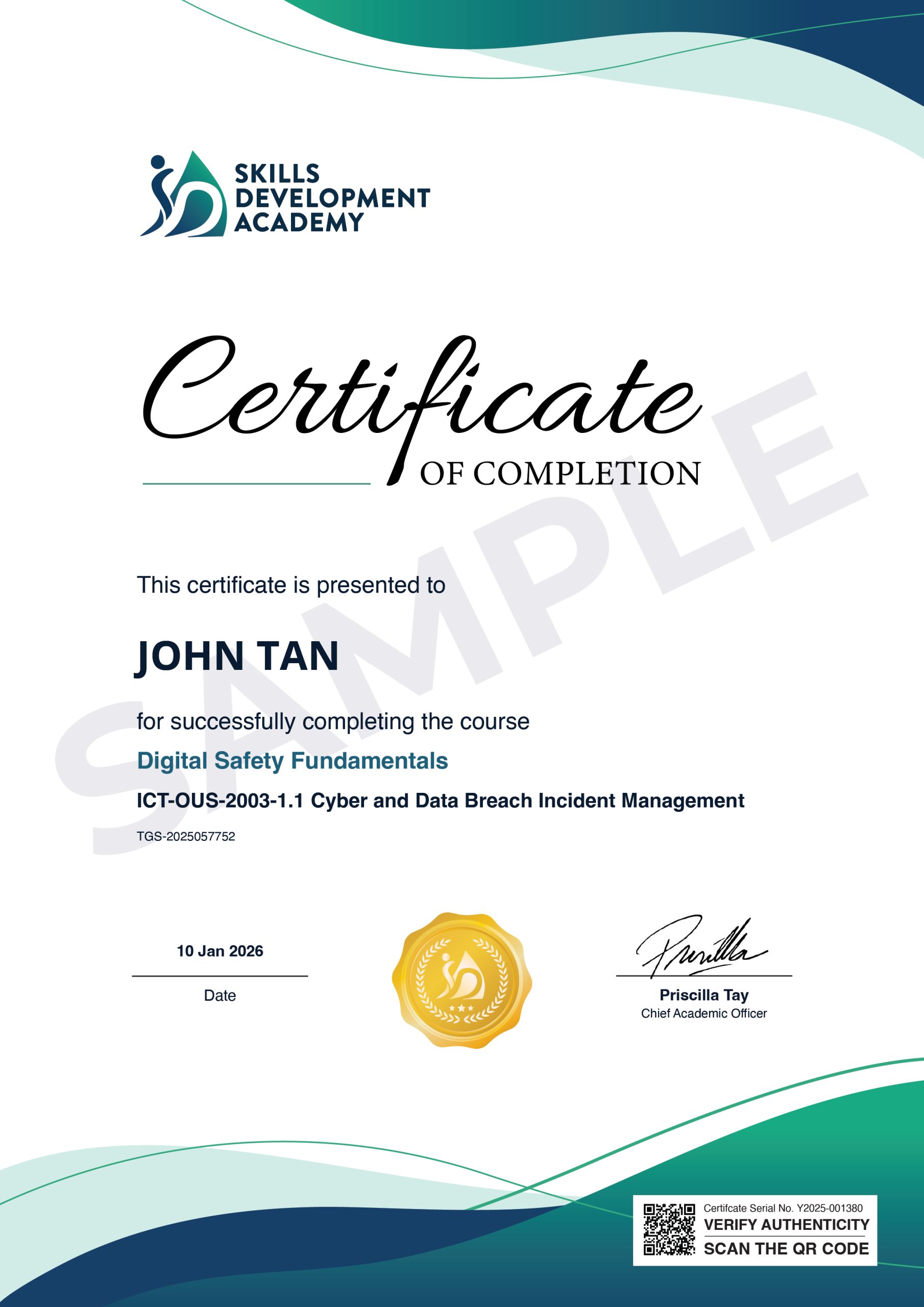
Candidates who complete each module with at least 75% attendance and demonstrate competency during assessment will receive a Certificate of Completion by Skills Development Academy and a WSQ Statement of Attainment.

Entry Requirements:

  • Aged 18 and above
  • Have basic computer literacy Level 2
  • Have minimum GCE “N”, “O” or “A” Level / NITEC or a diploma qualification and minimum 2 years of working experience; and
  • Have an English language proficiency equivalent of higher of any of the following – GCSE N/O Levels pass in English / WPLN Level 5 / IELTS 5.5 / TOEFL (internet based total) 46-59

Enquire About Our Courses

Ready to Upskill? We’re here to Support You.

    View Full Pricing

    Course Fees & Subsidies

    Singapore Citizens (40 years and above)
    Course Fees (Before GST)
    9% GST
    70% SkillsFuture (SSG) Subsidy
    Nett Fee
    Singapore Citizens (21-39 years old) & PR
    Course Fees (Before GST)
    9% GST
    50% SkillsFuture (SSG) Subsidy
    Nett Fee

    Additional Support

    SkillsFuture Credits eligible for Singapore citizens aged 25 & above

    PSEA eligible for Singapore citizens aged 30 & below

    NTUC UTAP members can have up to 50% reimbursement on out-of-pocket cost

    • Nett Fee are inclusive of GST charged based on the full course fees.
    • Subjected to individual’s eligibility and availability of SkillsFuture Credit.
    • NTUC UTAP reimbursement is capped at $250 for members aged below 40 or $500 for members aged 40 & above.
    SMEs
    Course Fees
    70% SkillsFuture (SSG) Subsidy
    Nett Fee
    Non SMEs
    Course Fees
    50% SkillsFuture (SSG) Subsidy
    Nett Fee

    Additional Support

    Additional Support via Absentee Payroll

    Enterprise Innovation Scheme 

    Option 1    Up to 400% Tax Deduction

    Option 2    20% Cash Payout Based On Nett Fee

    Up to 90% Additional Subsidy from SkillsFuture Enterprise Credit (SFEC) 


    SME Eligibility Criteria

    • Registered or incorporated in Singapore
    • Employment size of not more than 200 (at group level) or with annual sales turnover (at group level) of not more than $100 million